Mission
Triathlon BC is committed to supporting the values universally acknowledged as the essence of sportsmanship; specifically, safety, honesty, fair play, cooperation, competitive spirit, respect for rules, and respect for all others involved in the sport, without prejudice to race, colour, creed, gender, or physical ability.
Triathlon is the only sport where athletes with a disability compete alongside their able-bodied counterparts at a local, national, and international level.
Triathlon BC is proud to offer a Paratriathlon categoryat all sanctioned races. If you are interested in competing, organizing a race, or learning more, please see the links below or contact us at info@tribc.org. See you at the races!
Download the Race Directors Guide to ParaTriathlon HERE.
View the full Provincial Race Calendar HERE.
View the National Race Calendar HERE (includes National Championships and World Championship Qualifying events)
Paratriathlon Rules & Categories
Triathlon BC uses the same rules and categories as Triathlon Canada and the ITU. The specific rules that pertain to Athletes with a Disability are included below.
P1 GeneralFor Paratriathlon participants in any competition sanctioned by or conducted under the auspices of the Triathlon Canada (TC), the rules of that organization will apply with only the specific modifications:
* NEW * Please note part d) below (minimum disability rule).
- Paratriathletes, as defined under ITU rule P.2 (see Categories above) will be governed by all International Triathlon Union (ITU) competition rules with the following specific modifications.
- Prior to attending the ITU World Championships all Paratriathletes are required to provide a doctor’s letter to their National Federation, outlining their degree of disability.
- Athletes are required to be classified by an ITU desiganated classification officer to ensure athletes are assigned to the proper category.
- For an athlete to be elible for categories TRI1, TRI2, TRI3, TRI4 and TRI5, the athlete must have a minimum disability of 15% impairment of a limb.
P2 - Competition Categories
Physically Challenged Competition Categories shall be established based on physical disabilities. Medical evidence shall be required as to disability and classification at National and International Events. The six categories as of January 1, 2008 are as follows:
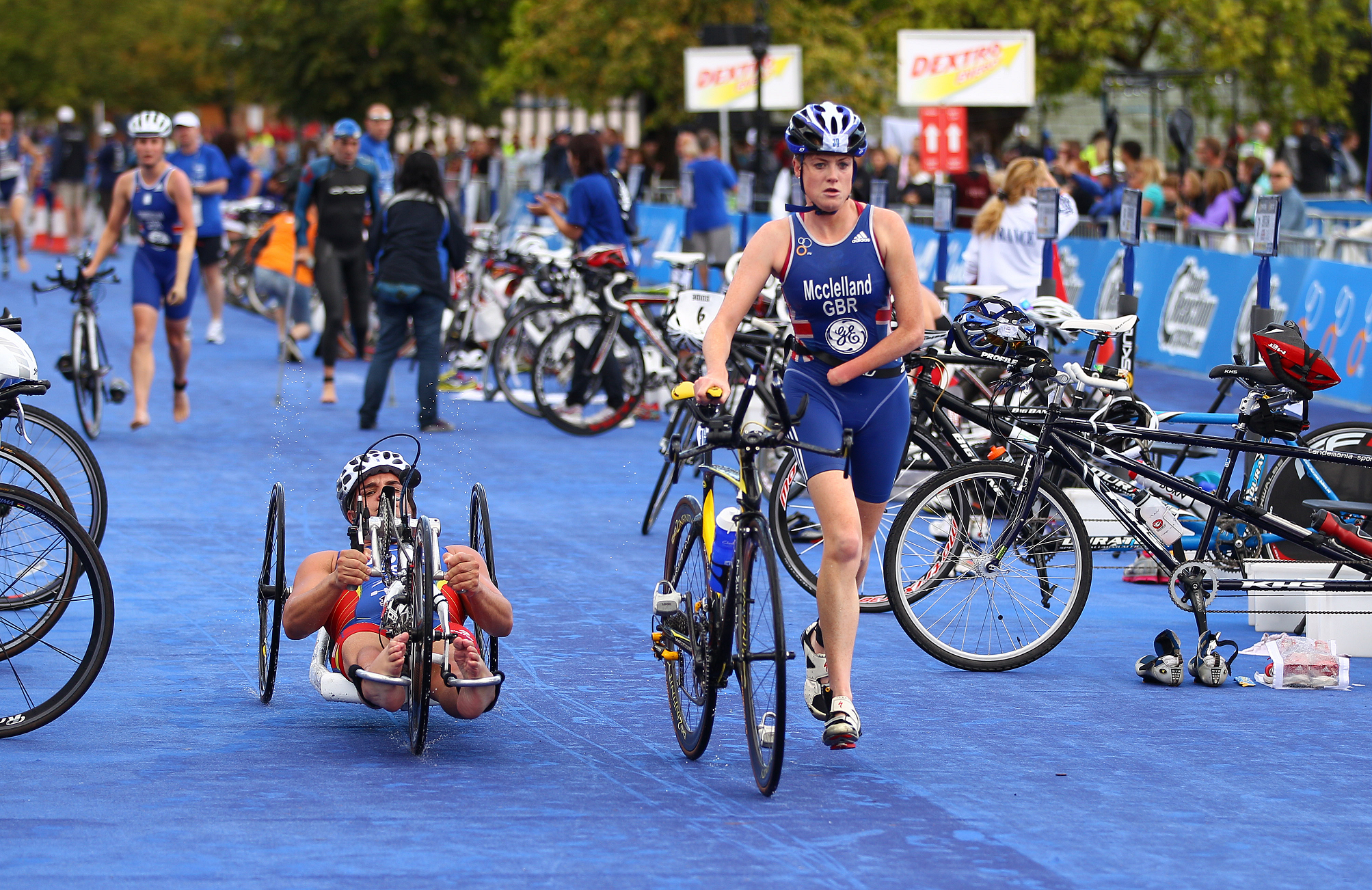
TRI 1 - Handcycle: Paraplegic, Quadriplegic, Polio, Double Leg Amputee. Must use
hand cycle on bike course and racing wheel chair on run.
TRI 2 - Severe leg impairment including above knee amputees. Athlete must ride bicycle and run with above knee prosthesis (or similar prosthesis) or run using crutches.
TRI 3 - Les Autre: This category includes athletes with Multiple Sclerosis, Muscular Dystrophy, Cerebral Palsy, double leg amputee runners or paralysis in multiple limbs. These athletes will ride a bicycle and run. They may use braces or prosthesis if required.
TRI 4 - Arm impairment including paralysis, above elbow amputees and below
elbow amputees, or impairment in both upper limbs. Athletes may use prosthesis, brace or sling on the bike and/or run.
TRI 5 - Slight leg impairment including below knee amputees. Athlete rides bicycle and runs with prosthesis.
TRI 6 - Visual Impairment, legally Blind (20/200 vision with best corrective vision). A handler of the same sex is mandatory throughout the race. Athlete is tethered during the swim. Athlete uses a tandem bicycle and may be tethered during the run.
P.3. Transition Area Conduct
- Assistance to paratriathletes in and out of the water; to and in transition shall be permitted.
- Assist dogs will not be allowed at any time.
- Securing qualified aides (handlers) shall be the responsibility of the triathlete and all such handlers shall be identified to the referee well prior to the event.
- It is intended that each triathlete have adequate assistance with appropriate credentials,
- 1 handler for upper extremity amputees and the blind
- Blind athletes must be guided by a guide of the same sex throughout the entire course (i.e. tandem on bike)
- 2 handlers for lower extremity amputees
- 2-3 for paraplegics, quadriplegics, polio) , to ensure safety and fair competition.
- All handlers shall be subject to rules of competition and further instructions deemed appropriate by the referee.
- Any infraction perpetrated by a handler that enhances the performance of one triathlete over another may in the discretion of the referee or protest committee be grounds for a time penalty or disqualification imposed on the triathlete whose performance was enhanced.
P.4. Swimming Conduct / Equipment a) Artificial propulsive devices, including but not limited to fins, paddles, or floating devices of any kind will not be allowed resulting in disqualification.
b) Wetsuits will be allowed, at all temperatures. It will be left up to the athlete to determine if it is too warm to wear a wetsuit.
P.5. Cycling Conduct / Equipment PLEASE REFER TO THE RACE DIRECTORS MEMO ON OUR OFFICIALS PAGE FOR AN UPDATE ON BICYCLE ELIGIBILITY. CLICK HERE TO LINK TO THE MEMO.
- All bicycles, tricycles, hand cycles shall be propelled by human force. Arms or legs shall be used to propel the cycle but not both. Prostheses are permissible. Any violation shall result in disqualification.
- For AWAD triathletes bicycle shall include bicycle, tricycle, hand cycle and or racing wheelchair.
- Bicycle specifications as to length, height, width, number of wheels, “front to center” distance with respect to hand cycles and tricycles shall conform to international paralympic standards. In the interim such vehicles shall conform to those in general use and shall be subject to inspection by the referee before the event to ensure safety and fair competition.
- There will be no protective shield, faring or other device that has the effect of reducing resistance used. Aerodynamic carriers must not be attached to handlebars of tricycle or hand cycle.
- There must be at least one working brake (generally on the drive wheel) capable of safely stopping/ slowing the vehicle.
- AWAD triathletes who use a bicycle shall be governed by the aforementioned specifications regarding length, height, width, number of wheels, and front to center distance.
P.6. Running Conduct / Equipment
- Paratriathletes may use prosthesis, canes or crutches to ambulate the course.
- The only acceptable footwear on the run portion is a running shoe unless a prosthetic limb like a flexfoot is necessary.
- Paratriathletes who perform this leg in a wheelchair shall be governed by the rules of TC, and shall include wheelchair specifications as well as racing conduct.
- Wheelchair Specifications: The wheelchair shall have at least two large wheels and one small wheel. The wheelchair design must not incorporate any device to enhance its aerodynamic capacity. (Note: “Wheelchair design does not include wheels”; all wheels may be spoke solid or composite construction. Wheel covers are permitted). The maximum diameter of the large wheel including the inflated tire shall not exceed 70 cm. and maximum diameter of the small wheel including the inflated tire shall not exceed 50 cm. Only one plain, round, standard type hand rim is allowed for each large wheel. No mechanical gears or levers shall be allowed that may be used to propel the chair. There is no limit on the length of the racing wheelchair. Only hand operated mechanical steering devices will be allowed. Athletes must ensure that no part of their lower limbs can fall to the ground during a race. Competitors may receive technical advice from cyclo computer type devices installed on their own wheelchairs.
- In no instance may an paratriathlete for this leg use a bicycle, hand cycle, tricycle or motorized vehicle or other equipment used in the cycling leg. It is permissible however to use a legal “racing wheelchair” as that defined above in the cycling leg and the running leg of a triathlon providing there is no risk to the safety of any participant or time violation (e.g., meeting cutoff time established by the referee). The triathlete, must provide proof in advance that he/she has completed the cycling distance in his/her racing chair in a verifiable time not greater than the time required by the referee for cyclists to complete the course.
P.7 AWAD Visual Impairment Category Conduct
The following additional rules apply to blind athletes and their guides:
- Blind athletes must use a guide of the same gender in competition and (with few exceptions) must furnish their own guide.
- The blind athlete is to be tethered during the swim.
- The blind athlete and guide shall use a tandem bicycle.
- The blind athlete may choose to use an elbow lead, tether lead or to run free. The runner may receive verbal instruction only from his/her guide.
- No triathlete registered as an elite nor cyclist registered with a UCI trade team may participate as a guide.
- Paddle boards, kayaks, bicycles, motor bicycles or any other mechanical means of transport may not be used by guides on the swim or run.
- At no time may the guide "lead" or "pace" the athlete nor propel the athlete forward by pulling or pushing.
- Whether or not a tether is being used, the athlete and guide shall not be more than 0.5 meters apart at all times.
- As the blind athlete crosses the finish line, the guide must be beside or behind the athlete but not further than the required 0.5 meter maximum separation distance.
- Infringement of any these rules may, at the discretion of the Head Referee, be grounds for a time penalty or disqualification (DQ).
Resources & Links
The following resources and links are not affiliated with Triathlon BC, but may be of interest:
| www.bcblindsports.bc.ca |
BC Blind Sports |
| www.amputee.ca |
A useful collection of other links regarding sport, prosthetics, community groups and clubs etc. |
| www.bcwheelchairsports.com |
BC Wheelchair Sports |
| www.enablelink.org |
Another site with tons of information. Under the ‘Sports and Recreation’ tab find: articles, links, organizations and a message board. |
www.aasra.ab.ca/
|
Alberta Amputee Sport and Recreation Association – Go to the ‘resources’ tab – huge list with many Canada-wide links. |
| www.dsusa.org/ |
Disabled Sports USA - Useful resource. Check Challenge Magazine tab, Links. |
| www.ossur.com |
Premier manufacturer of prosthetic equipment. Inspiring stories in the ‘Team Ossur’ section. |
| home.wi.rr.com/birzer |
Wheelchair racing page. Lots of links to resources, info, equipment etc. |
www.ala.ca/content/home.asp
|
Active Living Alliance - Provides great info for Canadians living with a disability. |
Submit a link
If there is a useful, informative website that you think would be helpful, please CLICK HERE and let us know about it. Thank You!
Race Director’s Resources - Please see the Race Sanctioning Application on the page “Sanctioning and Race Directors” |